 GameKeepr
The security model
Written down so decisions are deliberate, not accidental.
The centre of gravity
GameKeepr holds the Docker socket, which is root-equivalent on the host. Everything else follows from taking that seriously:
- Clients never name containers. Every request addresses a server id, and the only ids that exist are the ones in
servers.jsonplus what the portal itself deployed. There is no code path from user input to an arbitrary container. - The portal never deploys privileged containers and never adds capabilities — refused in code, not in review.
- Operator accounts can change what runs on the machine. Treat handing out the operator role as handing out the machine.
Doors and identities
Two independent layers: Cloudflare Access (email codes, keeps the internet out) and GameKeepr's own accounts (scrypt-hashed passwords, per-browser sessions, roles). Rate-limited logins, one-time passwords for new accounts, sessions visible and revocable by the owner.
What third-party code gets to do
- Mods are downloaded only from known repositories or uploaded by an operator; archives are parsed and judged before a byte is unpacked (path traversal, symlinks, device nodes, compression bombs), hashes verified where the repository publishes them, optional scanners consulted. No report ever says "safe" — that claim is not available.
- Steam-composed servers trust Valve's official image and Steam's depots; the start script in between is generated, visible in the Files tab, and runs the game as an unprivileged user (
99:100), never root. - Templates are reviewed before deploy; untrusted publishers and privileged requests are refused.
Honesty rules
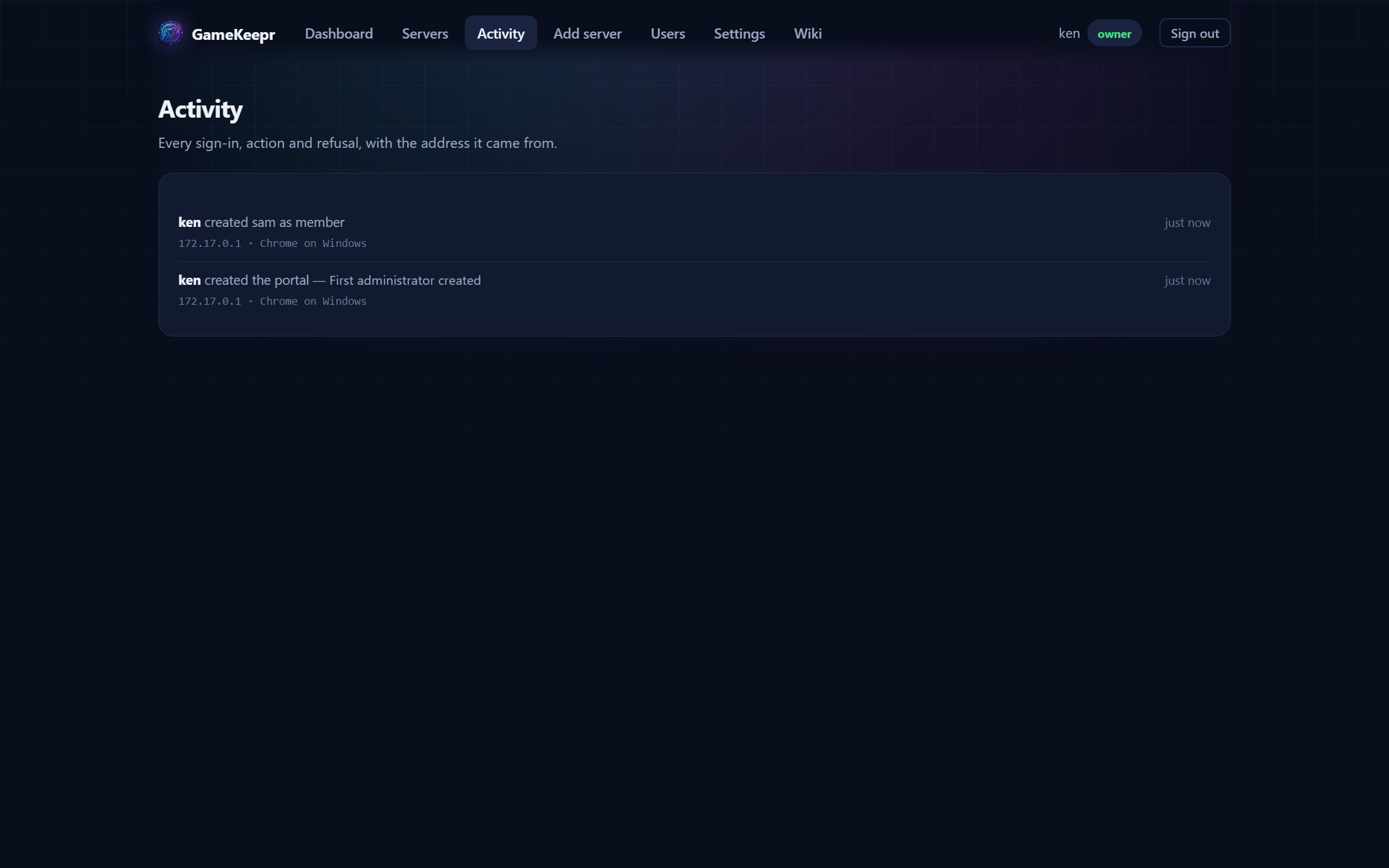
Things someone may not see answer 404, not 403 — a hidden server, a wiki page above your role. Telling someone a thing exists is itself a disclosure. Audit rows record rejections as well as successes; the rejections are the interesting ones. Secrets are encrypted at rest, masked in every UI, and never echoed back.
Narrowing the socket
The optional dockerproxy service in the compose file puts a filter between GameKeepr and the Docker socket, passing only the API groups it uses (containers, images, networks, exec, POST) and refusing the rest — volumes, secrets, swarm, system and plugins all answer 403. The preset is tested against every feature, deploys included.
Be honest about what it buys: GameKeepr legitimately needs container creation and exec, and the proxy cannot inspect request bodies, so it is defence-in-depth, not a sandbox. The unforgeable rule remains the one in GameKeepr's own code: no privileged containers, no client-named containers.
Unraid's built-in API (7.2+) offers scoped API keys, but its schema can control containers, not create them — nor exec, attach or read files — so it cannot carry GameKeepr's feature set today. Worth revisiting as it matures.
What to rotate when
SESSION_SECRET invalidates all sessions and stored integration secrets — rotate it only deliberately. Integration keys (VirusTotal, UniFi, the Discord webhook, tunnel tokens) rotate at their own services; GameKeepr stores only encrypted copies and survives any of them changing.